
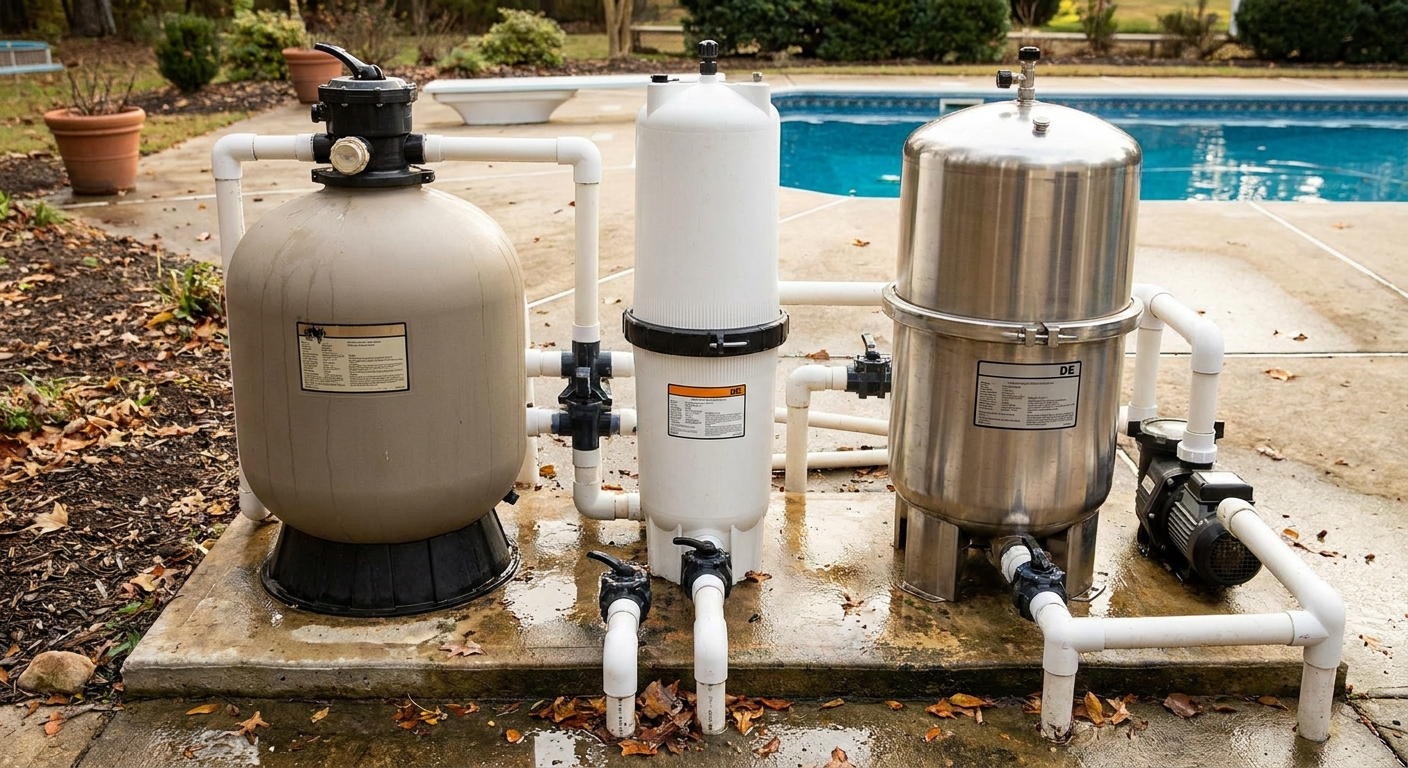
A swimming pool filter plays a critical role in keeping the water clean and safe.
While chemical sanitizers kill bacteria, they do not remove physical debris from the water.
The filter captures organic contaminants, dead algae, body oils, sunscreen, and fine particles that would otherwise make the water appear cloudy.
Without a properly functioning filter, even the most carefully balanced pool chemistry will not produce clear water.
The filter is positioned between the pump and the return lines in the circulation system.
Water flows from the pool through the skimmer and main drain into the pump, then through the filter medium, and finally back into the pool.
The medium traps particles that are too small for the skimmer basket to catch.
As debris accumulates, flow resistance increases, which is measured by the pressure gauge on top of the filter tank.
When resistance becomes too high, filtration efficiency drops and the pump works harder than necessary.
There are three main types of residential pool filters: sand, cartridge, and diatomaceous earth (DE).
Each type operates differently, filters particles to a different level of fineness, and requires distinct maintenance routines.
Understanding these differences helps pool owners choose the system that best suits their needs.
DE Pool Filters
DE stands for diatomaceous earth, a naturally occurring sedimentary rock made from fossilized remains of tiny aquatic organisms called diatoms.
This material crumbles into a fine powder that is used as a filtration medium.
In DE pool filters, the powder adheres to cloth-like grids inside the tank and captures debris as water passes through.
DE filters are capable of filtering particles down to 2 to 5 microns, making them the most effective option for achieving crystal-clear water.
The difference in clarity is especially noticeable when swimming at night in a lighted pool.
These filters are most commonly used with in-ground pools, although models are available for above-ground pools as well.
Upfront costs are higher compared to other types, but the superior filtration performance is a significant advantage.
Routine maintenance for DE filters involves backwashing when the pressure gauge reads about 25 percent above the clean baseline.
After each backwash, fresh DE powder must be added to recharge the filter.
A complete tear-down of the filter to clean the grids is recommended once a year.
The cloth-like grids typically last three to four years before they need replacement.
Some local regulations require a separation tank to capture the DE powder during backwashing, which adds to both the cost and space requirements.
Sand Pool Filters
Sand filters consist of a large tank filled with pool-grade silica sand.
Water enters the tank and passes through the sand, which traps dirt, debris, and other contaminants before the clean water returns to the pool.
Standard sand filters catch particles down to about 20 to 40 microns, which is the largest particle size of the three filter types.
Sand filters are widely appreciated for their simplicity and low maintenance.
The main cleaning method is backwashing, which involves reversing the water flow to flush out trapped debris.
This process takes about five minutes and is straightforward to perform using the multiport valve.
The sand itself only needs replacement every three to seven years, depending on water chemistry and debris load.
Some pool owners use alternative filter media such as zeolite or filter glass to improve filtration performance.
The initial purchase price of a sand filter is generally the lowest among the three types.
However, because sand filters allow finer particles to pass through, the water may not be as clear as with a DE or cartridge system. Adding a clarifier chemical can help improve clarity.
Sand filters are a practical choice for pools with heavy debris loads and for owners who prefer a low-effort maintenance routine.
Cartridge Pool Filters
Cartridge filters use one or more cylindrical filter elements made of pleated polyester fabric.
These elements sit inside a tank, and water flows through the pleated material before cycling back into the pool.
The large surface area of the pleats allows efficient filtration with less strain on the pump.
Cartridge filters typically catch particles down to 10 to 15 microns, placing them between sand and DE filters in terms of filtration effectiveness.
One of the main advantages of cartridge filters is water conservation.
Unlike sand and DE filters, they do not require backwashing, which can waste hundreds of gallons of water per cleaning.
Instead, the cartridges are removed periodically and rinsed with a garden hose.
A deep cleaning with a filter degreaser solution every few months helps dissolve oils and sunscreen that hose rinsing alone cannot remove.
Cartridges need replacement every two to three years, or sooner if tears or damage are noticed during cleaning.
Cartridge filters are popular for both in-ground and above-ground pools. They are energy-efficient, simple to maintain, and provide a good balance of filtration quality and cost. For smaller pools and pools in areas with water-use restrictions, cartridge filters are often the preferred choice.
Choosing the Right Filter for Your Pool
Selecting the best filter depends on several factors including pool size, desired water clarity, maintenance preferences, and budget.
Sand filters are durable, easy to operate, and cost-effective, but they filter the largest particles.
DE filters offer the finest filtration and the clearest water, but they require more hands-on maintenance and have higher upfront costs.
Cartridge filters provide a middle ground with good filtration, water savings, and moderate maintenance requirements.
When choosing between sand, cartridge, and DE filters, a pool filter types explained breakdown makes it easier to weigh cleaning efficiency, upkeep, and replacement costs.
Regardless of the filter type chosen, regular maintenance is essential for long-term performance.
Monitoring the pressure gauge and cleaning the filter when the reading rises about 25 percent above the clean baseline will keep the system running efficiently.
A neglected filter not only reduces water clarity but also forces the pump to work harder, increasing energy costs and potentially damaging equipment.
By understanding the differences between sand, cartridge, and DE filters, pool owners can make an informed decision and enjoy clean, clear water all season long.
