
Nobody warns you about this part.
You hear about the sleepless nights. The feeding schedules. The diaper changes. But nobody sits you down and says, “Hey, your relationship is going to feel completely different after the baby arrives.”
And it does. For almost every couple, it does.
That doesn’t mean it’s broken. It just means it needs attention — the same way your baby does. The good news is that small, consistent efforts actually work. You don’t need grand gestures. You need the right habits.
Here’s what real moms have found helpful, and what relations tips fpmomhacks experts actually back up.
Why Relationship Tips Fpmomhacks After a Baby
First, let’s be honest about what’s happening so you don’t blame yourself or your partner unfairly.
When a baby comes home, everything shifts. Sleep drops, stress rises, and the two people who used to talk freely now spend most of their energy keeping a tiny human alive. According to research from the Gottman Institute, around 67% of couples report a significant drop in relations tips fpmomhacks satisfaction in the first three years after having a baby. That’s not a small number.
Here’s what usually happens:
- You’re both exhausted, so small irritations feel bigger
- Physical and emotional intimacy often decreases
- You stop talking about “us” and only talk about “the baby”
- One or both partners feel unseen or unappreciated
None of this is your fault. It’s biology and circumstance. But it is something you can work on.
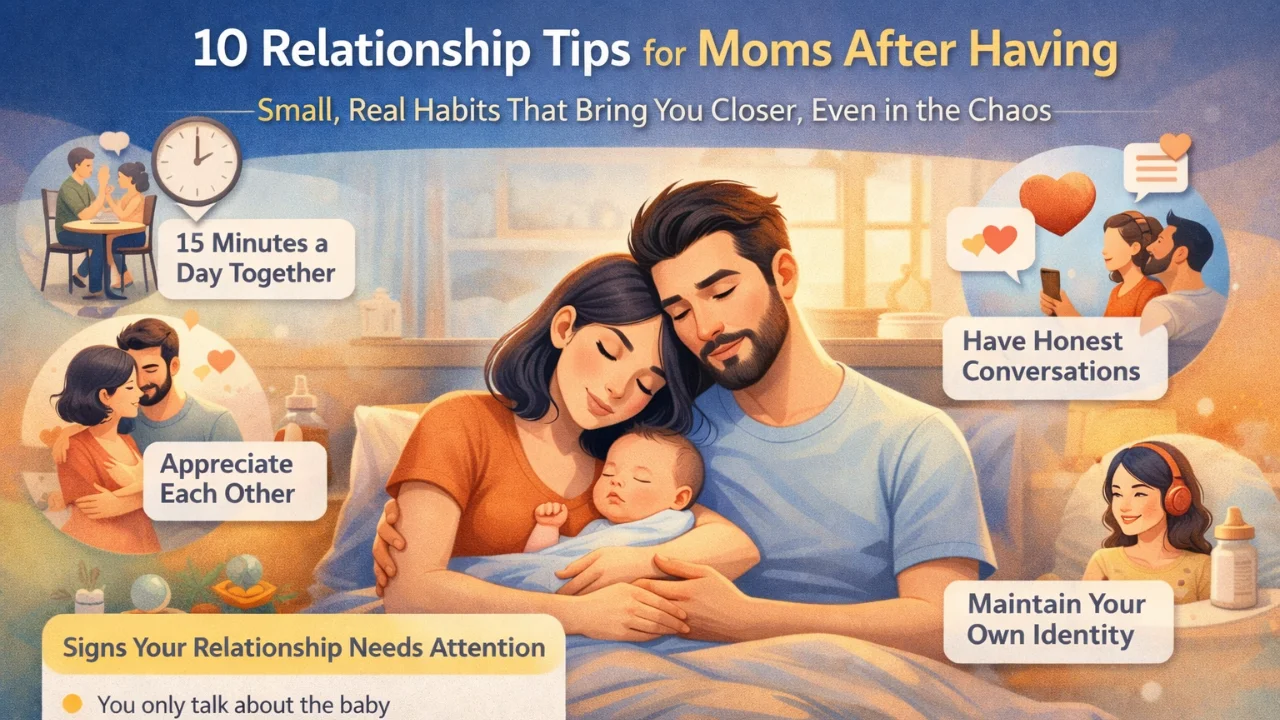
10 Real Relationship Tips for Moms That Actually Help
1. Talk About It — Even When It’s Uncomfortable
Most couples stop having real conversations after a baby because there’s no time or energy left. But staying quiet about how you’re feeling is what creates real distance.
You don’t need a long therapy session. A five-minute check-in at the end of the day is enough. Something like: “I felt overwhelmed today. How are you doing?”
It opens the door. That’s what matters.
2. Stop Keeping Score
This one is hard but important. When you’re both exhausted, it’s easy to start tracking who did more — who got up last night, who made the last meal, who hasn’t had a break.
Scorekeeping kills goodwill fast.
Try shifting to a team mindset instead. Ask your partner, “What do you need this week?” and share what you need too. When both people feel heard, the scoreboard disappears.
3. Protect 15 Minutes a Day Together
You don’t need a date night at a fancy restaurant. You need consistency.
Even 15 minutes of actual connection — phones down, baby asleep, just talking or sitting together — makes a real difference. Couples who do this regularly report feeling more connected and less resentful, even during stressful periods.
Put it in your routine like a habit, not a luxury.
4. Say What You Appreciate Out Loud
When everything feels like a chore, it’s easy to forget that your partner is also trying. And most people, when they feel unseen, pull away.
A simple “thank you for doing that” or “I noticed you handled that tonight” takes five seconds and lands hard. Research from Dr. John Gottman shows that couples who maintain a 5:1 ratio of positive to negative interactions are significantly more stable and satisfied.
That’s five small positives for every one negative. It’s achievable.
5. Don’t Put Off the Hard Conversations
New moms often push down frustrations because they don’t want to add to the stress. But those pushed-down feelings pile up, and eventually they come out — usually at the wrong moment.
If something is bothering you, name it early and calmly. “I’ve been feeling disconnected from you lately” is a much easier conversation than the explosion that comes later.
Early and calm beats late and explosive every time.
6. Keep Physical Closeness Alive — In Small Ways
Intimacy doesn’t only mean sex. It means touch, eye contact, and small moments of warmth.
A hug that lasts more than three seconds. Holding hands on the couch. Making eye contact and smiling when your partner walks in. These small physical moments release oxytocin — the same bonding hormone that helps you connect with your baby.
Don’t underestimate how much a hug can reset a hard day.
7. Ask for Help Before You Hit Empty
One of the most damaging relationship patterns for new moms is waiting until they’re completely burned out to ask for support. By that point, everything feels urgent and overwhelming, and it’s easy to direct that frustration at your partner.
Catch it early. Say “I’m starting to feel really stretched thin — can we figure out a plan together?” before it becomes a crisis.
Your partner can’t read your mind. Most of the time, they want to help. They just need to know what you actually need.
8. Maintain Your Identity Outside of Mom
This one is often overlooked in relations tips fpmomhacks and advice, but it matters a lot.
When you lose yourself entirely in motherhood, you lose the version of yourself that your partner fell in love with — and that you need for your own mental health. Keeping even one thing that’s just for you (a hobby, a walk alone, a podcast you actually enjoy) keeps you grounded.
A grounded, self-connected person is a better partner. That’s not selfish. That’s just true.
9. Handle Conflict Calmly — Especially in Front of the Baby
Babies pick up on emotional tension faster than most people realize. And how you argue matters as much as whether you argue.
If a conversation is escalating, it’s okay to pause. Saying “Let’s talk about this tonight when we’re calmer” isn’t avoidance. It’s smart management of a real situation.
What you want to avoid is letting conflicts spiral into attacks on each other’s character. Stick to the issue, not the person.
10. Celebrate Small Wins Together
New parenthood is genuinely hard. But it’s also full of small, beautiful moments — the first real smile, the first full night of sleep, making it through a tough week together.
Acknowledge those moments with your partner. “We did that” is a powerful phrase. It builds a shared story, and that shared story is the foundation of a strong relations tips fpmomhacks.
A Quick Guide: Signs Your Relationship Needs Attention
Use this simple check-in to see where you are:
| Signal | What It Means |
|---|---|
| You mostly talk about the baby, not each other | Normal at first, but work on balance |
| You feel more like roommates than partners | Time to add intentional connection |
| Small things make you disproportionately angry | Usually a sign of unspoken resentment |
| You can’t remember the last time you laughed together | Start small — a funny video, a shared memory |
| You feel grateful for your partner often | You’re in good shape — keep going |
What Real Moms Say Actually Helps
From experience and what moms in parenting communities consistently share, a few things come up again and again:
“We started having one honest conversation a week where we each say what was hard and what we appreciated. It changed everything.”
“I stopped expecting my husband to just know. I started saying it out loud. Way less frustration now.”
“We gave each other one solo hour a week, no questions asked. It sounds small but it helped us both feel human again.”
These aren’t magic formulas. They’re small, consistent habits. And they work because they’re built on respect and honesty — which is really what every strong relationship runs on.
Conclusion
Your relations tips fpmomhacks won’t look the same after having a baby. That’s okay. It doesn’t have to.
What matters is that you keep choosing each other, even in the messy, exhausted, beautiful middle of new parenthood. Small conversations, honest feelings, and five minutes of real attention go further than you think.
You’re not just raising a child together. You’re building something. Treat it like it matters — because it does.
FAQs
Q1. How do relationships change after having a baby?
After a baby, your routine, sleep, and priorities change. Couples often talk less, feel tired, and have less time for each other. This is normal, but it needs effort to stay connected.
Q2. Is it normal to feel distant from your partner after a baby?
Yes, it’s very common. Many couples feel emotionally or physically distant in the first months. It doesn’t mean your relationship is failing — it just needs attention.
Q3. How can new moms keep their relationship strong?
Focus on small things like daily communication, appreciation, and spending a few minutes together without distractions. Consistency matters more than big efforts.
Q4. Why do couples argue more after having a baby?
Lack of sleep, stress, and new responsibilities can make small issues feel bigger. Both partners may feel overwhelmed, which leads to more arguments.
Q5. How much time should couples spend together after a baby?
Even 10–15 minutes daily of quality time is enough. The key is being fully present — no phones, no distractions.
Q6. How can I improve communication with my partner after a baby?
Start with simple, honest conversations. Share how you feel and ask how your partner is doing. Short daily check-ins can make a big difference.
